



What Kind of Fleece Is This?

A practical guide to identifying fleece fabric, understanding how it behaves and choosing what to make with it.
You see a fabric. It is soft, squishy and cozy. You either want to make something wonderfully comfortable from it, or you want to wrap yourself in the whole roll and stay there.
Either way, you know it is fleece.
But that may be almost everything you know about it.
At FABCYCLE, that is often exactly where we begin. The deadstock and recovered fabrics we receive rarely arrive with complete manufacturer information. Sometimes there is no bolt label, no fibre tag and no technical description—just the fabric itself and all the clues it carries.
Over time, we have developed ways of assessing those clues through experience, research and a lot of handling fabric. We look at the face and backing, test the stretch and recovery, compare the loft and density, and consider where the material came from.
Fleece can be particularly confusing because fleece is a broad family name rather than one exact fabric. One shop may describe something as microfleece while another calls a very similar material lightweight polar fleece. Sherpa, teddy fleece and high-pile fleece can overlap. Even two fabrics sold under the same name may have very different stretch, recovery and weight.
So instead of beginning with What was this fabric called?, let us begin with the more useful question: What does this fabric actually do?
How this guide was developed: Because deadstock fabrics rarely arrive with complete labels or specifications, this guide draws on years of hands-on fabric assessment at FABCYCLE, supported by textile research and the clues we gather from construction, touch, stretch, recovery, provenance and fibre testing.
How can you tell what kind of fleece you have?
Start by comparing the two sides. Find the description below that looks most like your fabric, then open it to see what it is likely to be, what to check next and what it may be good for.
Both sides are soft, brushed or fuzzy Your fabric is probably polar fleece
Polar-style fleece usually has a raised, softly brushed surface on both sides. One side may look slightly smoother or more finished, but there is no obvious jersey face or looped reverse.
A fine, lower-profile version may be described as microfleece. Heavier versions may be labelled by weight or simply sold as medium- or heavyweight polar fleece.
One side is smooth and the other is brushed or fuzzy Your fabric is probably sweatshirt fleece
Sweatshirt fleece usually has a smooth jersey-like exterior and a brushed interior. It behaves more like a substantial garment knit than classic double-sided polar fleece.
Fibre content and behaviour can vary considerably. One sweatshirt fleece may be cotton-rich and quite stable, while another may contain elastane and have much stronger stretch and recovery.
One side is smooth and the back has visible loops Your fabric is probably French terry rather than fleece
French terry and sweatshirt fleece are closely related constructions. French terry retains visible loops on the reverse instead of having them brushed into a fuzzy surface.
French terry is usually less lofty and less insulating than sweatshirt fleece, making it useful when you want the comfort of a substantial knit without quite as much warmth.
One side is curly, fluffy, woolly or sheep-like Your fabric is probably sherpa, teddy or high-pile fleece
Sherpa and teddy fleece usually have a dimensional pile on one side and a flatter knitted backing on the other. The pile may be curly, pebbled, silky or irregular.
These names overlap heavily. The more useful distinctions are the height of the pile, the stability of the backing and how bulky the fabric becomes once several layers meet.
The back has raised squares, channels or a visible grid Your fabric is probably grid or technical fleece
Grid fleece uses raised areas to retain insulating air while the lower channels reduce bulk. The grid may be subtle or immediately visible.
Many grid fleeces are designed for movement and layering. They may have excellent stretch and recovery, but the open structure can allow wind to pass through more easily than a dense outer fabric.
The fleece is joined to a second, different-looking layer Your fabric is probably bonded fleece
Bonded fleece combines a fleece layer with another knit, woven fabric or smooth synthetic surface. The layers may be permanently laminated or lightly bonded together.
A smooth outer face does not automatically mean that a fabric is waterproof or windproof. Those are specific performance properties that should be confirmed separately.
None of these descriptions quite matches?
That is normal. Fabric categories overlap, and manufacturers do not all use the same naming system. Describe what you can actually observe: the two surfaces, the backing, the stretch, the recovery, the weight, the density and the pile.
You do not need the perfect commercial name before you can make a good sewing decision.
Now test what it does
Four behaviours that matter more than the name
Stretch and recovery
This deserves special attention because it determines whether the garment can be put on, move with the body and return to its original shape.
Mark a relaxed 10 cm section and stretch it comfortably without forcing it.
10 cm stretching to 13 cm= approximately 30% stretch
Then release it. If it remains longer, ripples or slowly creeps back into place, avoid relying on it for negative ease, fitted knees, cuffs or waistbands.
Backing and construction
Separate the pile with your fingers. The structure beneath it may reveal jersey stitches, terry loops, a grid, mesh or a second bonded layer.
The backing often tells you more about how the fabric will sew than the soft surface does.
Loft, density and weight
These are related, but they are not interchangeable. Loft is the height and volume of the pile. Density is how closely packed the structure feels. Weight is the actual mass of the fabric.
A very lofty fleece can be surprisingly light because much of its volume is trapped air. A flatter fleece may be denser, heavier and more resistant to airflow.
Nap direction
Brush the fabric in both directions. If the colour, shine or texture changes, it has a directional nap.
Cut every visible garment piece with the pile running in the same direction or adjoining sections may appear to be different colours.
Sometimes the most useful identification is not “This is definitely one exact commercial type of fleece.”
It is: “This is a midweight, double-sided fleece with moderate crosswise stretch, limited lengthwise stretch, a directional pile and enough stability for a pullover, jacket, vest or blanket.”
For choosing a sewing project, that description may tell you everything you actually need.
Use behaviour, not guesswork
What should you sew with your fleece?
These are starting points rather than rigid rules. Always compare your fabric’s stretch, recovery and weight with the requirements of the individual pattern.
| How the fleece behaves | Project ideas | Pattern suggestion | What to watch |
|---|---|---|---|
| Stable or moderately stretchy fleece | Pullovers, hooded sweaters, relaxed layers and casual tops. | Thread Theory Finlayson Sweater A boxy pullover with a shawl collar or crossover hood. | Very bulky fleece may overwhelm the collar or hood. Test how several layers behave together. |
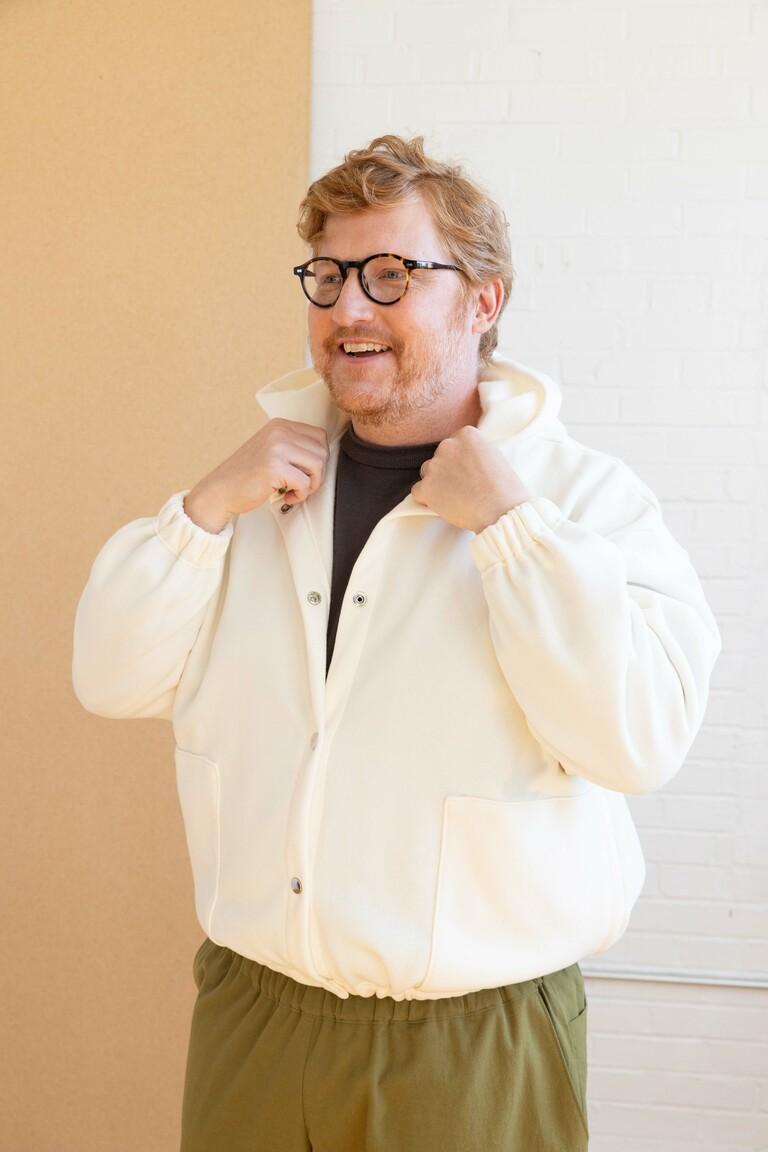
| Medium- to heavyweight sweatshirt fleece, French terry or sherpa | Cropped jackets, casual hooded layers and polished everyday outerwear. | Seamwork Andi Hooded Jacket A relaxed snap-front jacket with a hood, elasticated hem and sleeves, and polished pocket openings. The hood is a bonus variation used with the original Andi pattern. | The base pattern recommends fabric with no more than approximately 25% stretch. Test the bulk around the hood, front opening and elastic casings. |
| High-pile, teddy or sherpa fleece | Statement jackets, roomy layering pieces, long vests and lined outerwear. | Helen’s Closet Teddy Fleece Wildwood Jacket A real high-pile version with a hood, contrast binding and large curved pockets. | Control shedding and seam bulk, and consider basting or serging the outer and lining layers together. |
| Soft stretch fleece or sweatshirt fleece | Relaxed tops, tapered pants, matching sets and comfortable indoor clothing. | Closet Core Cielo and Pietra Fleece Set A fleece adaptation with an off-the-shoulder top and tapered elastic-cuff pants. | This is a pattern adaptation rather than the original fabric recommendation. Stretch, recovery and fitting should be tested carefully. |
| Stretchy but slow to recover | Relaxed tops, loose layers, blankets and accessories that will not remain under tension. | Choose a pattern with positive ease rather than a fitted design that depends on recovery. | Elbows, knees, seats, pocket openings and waistbands may grow or sag during wear. |
A little inspiration
Four very different things fleece can become
Fleece does not have to mean one particular kind of winter pullover. Depending on its stretch, weight, pile and structure, it can become a polished sweater, a cropped hooded jacket, an oversized teddy coat or a playful matching set.
Swipe to see more patterns →



Warmth for more than one season
Choosing fleece by weather, season and activity
Fleece is not only a winter fabric. Its usefulness depends on its weight, structure, the weather and whether you will be moving or sitting still.
Cool evenings and travel
Best starting point: microfleece or lightweight polar fleece.These add warmth without the volume of a heavy jacket and are useful for camping, coastal evenings, cabins, ferries, air-conditioned spaces and trips where the temperature changes quickly.
Walking, hiking and active use
Best starting point: stretch fleece or grid fleece.Look for strong recovery, comfortable movement and enough breathability for your activity level. Consider how the garment will fit beneath another layer.
Autumn and transitional weather
Best starting point: midweight polar fleece.Pullovers, vests and zip jackets are easy to add or remove as the temperature changes. A full zipper or deep neckline offers more temperature control than a closed heavyweight pullover.
Cold weather or low activity
Best starting point: dense, heavyweight or high-loft fleece.This is most useful when you are standing, sitting or producing less body heat. Fit, seam design and wind exposure can affect warmth as much as apparent thickness.
Indoor clothing and loungewear
Best starting point: sweatshirt fleece.Its smooth face and brushed interior usually make it more garment-like for hoodies, joggers, dresses and comfortable coordinated sets.
Stable fleece remnants can also become blankets, sleeping-bag liners, pet coats, hats, booties and neck warmers—useful projects for pieces that are too small for a full garment.
Technical fleece can do more than keep you warm
Some fleeces are engineered for a particular combination of warmth, breathability, stretch, moisture management, wind resistance or a water-resistant outer surface.
FABCYCLE receives deadstock from outdoor and technical-apparel production, so we encounter everything from lightweight grid fleece to dense fleece-backed and bonded fabrics. These materials can look similar while performing very differently, which is why the backing, stretch, density and complete construction matter as much as the fuzzy surface.
Fleece is warm, but it is not automatically weatherproof
Ordinary fleece is not inherently waterproof or windproof. In wet or windy weather, it usually works best as an insulating layer beneath a suitable outer shell.
Bonded and technical fleeces may offer additional protection, but those properties depend on their particular construction and finish rather than simply on being described as fleece.
Keep beside the machine
A compact fleece sewing guide
First: please just start
Do not let a table of needle types convince you that fleece requires perfect technical certainty before you can sew it.
Fleece is often quite forgiving. Choose a reasonable starting needle, sew a scrap with the same number of layers as the real seam, stretch the sample if the garment needs to stretch, and adjust only when the test tells you something is wrong.
| Fabric | Needle starting point | Stitch starting point | What to test |
|---|---|---|---|
| Stable polar fleece | Universal 80/12 or 90/14 | A regular straight stitch may work where the seam does not need to stretch. | Layer feeding, compression, visible holes and whether the seam can withstand normal movement. |
| Sweatshirt fleece | Jersey, ballpoint or stretch needle depending on the knit and fibre blend. | Narrow zigzag, stretch stitch or overlocker where the seam must expand. | Skipped stitches, curling, recovery and whether the seam stretches enough for the garment. |
| Stretch or performance fleece | Stretch 75/11 or 90/14 | A stretch-capable seam tested under realistic tension. | Recovery, skipped stitches, seam breakage and visible waviness. |
| Sherpa or high-pile fleece | Select the needle for the knitted backing rather than only the fluffy surface. | A slightly longer stitch may help when the pile is being heavily compressed. | Bulk, trapped pile, layer shifting and inaccurate seam intersections. |
| Bonded fleece | Choose for the complete bonded structure. | Test before deciding between a straight or stretch-capable seam. | Permanent holes, difficult feeding, separating layers and bulky enclosed seams. |
The problems worth solving
Practical fixes for the things fleece actually does
My seams are becoming much too bulky
- Grade enclosed seam allowances so the layers do not all end at the same point.
- Trim seam allowances more narrowly only after confirming that the seam remains secure.
- Use lighter ribbing, jersey, lining or woven binding instead of matching fleece in every component.
- On high-pile fleece, carefully reduce excess pile inside seam allowances where it creates unnecessary volume.
- Avoid placing thick facings, pockets, plackets and seam intersections directly on top of one another.
- Hand-baste the thickest intersections and turn the machine wheel manually through difficult points rather than forcing the fabric.
The layers keep shifting while I sew
- Use clips generously, especially when pins disappear into the pile.
- Hand-baste zippers, pockets and important intersections before machine stitching.
- Try a walking foot or reduce the presser-foot pressure if your machine allows it.
- Support the full weight of the garment so it does not pull the seam away from the machine.
- Sew with the more stable layer against the feed dogs when possible, then test whether the layers remain aligned.
The seam looks flat because all the pile is trapped inside it
- After sewing, gently tease trapped pile out of the seam with a blunt needle, point turner or similar tool.
- Work gradually rather than pulling aggressively, which can distort the knit backing.
- For very high pile, brush fibres away from the seam line before sewing and baste them into position if necessary.
- Test whether trimming pile from the seam allowance produces a cleaner result without exposing the backing.
The seam is stretching, rippling or becoming wavy
- Reduce presser-foot pressure if your machine provides that adjustment.
- Allow the machine to feed the fabric rather than pulling it from behind.
- Try a walking foot and test a slightly longer stitch.
- Stabilize shoulder seams, zipper edges and pocket openings where the fabric should not grow.
- Let the sample rest after sewing before deciding whether the waviness is permanent.
- Use minimal heat and steam only after testing, since synthetic fleece can flatten or distort.
I am getting skipped stitches or the stitch will not form properly
- Replace the needle first. A slightly damaged needle can behave badly on dense or stretchy fleece.
- Switch from a Universal needle to a Stretch needle when the fabric contains elastane or produces skipped stitches.
- Choose the smallest needle that reliably penetrates every layer.
- Rethread the machine with the presser foot raised and confirm that the thread is seated correctly in the tension discs.
- Test a slightly longer stitch when dense fleece is being compressed beneath the foot.
Zippers, pockets and closures look distorted
- Stabilize zipper openings before attaching the zipper, especially on stretchy fleece.
- Hand-baste the zipper rather than relying only on pins or clips.
- Use interfacing that suits the heat tolerance and stretch of the fabric.
- Reduce pile in hidden seam allowances if it prevents the zipper from sitting flat.
- Reinforce pocket openings so repeated use does not stretch them out of shape.
- Choose snaps and closures that can accommodate the full thickness of the finished layers.
The fabric is shedding everywhere
- Cut high-pile fleece with care and vacuum or collect loose fibres immediately rather than brushing them around the workspace.
- Finish or contain shedding edges where the construction requires it.
- Baste a high-pile outer fabric to its lining so the layers behave as one during assembly.
- Clean lint from the feed dogs, bobbin area and surrounding machine parts frequently.
- Do not rely on the fact that a knit does not technically fray; shedding and fraying are different problems.
How should I press fleece without flattening or damaging it?
- Test the lowest useful heat on a scrap before touching the garment.
- Press from the wrong side when possible.
- Use a pressing cloth and avoid leaving the iron stationary.
- Use finger pressing, clipping and careful topstitching when heat is unnecessary.
- Avoid crushing high pile directly against a hard ironing surface.
- Remember that some synthetic fleece can glaze, flatten or melt under excessive heat.
Frequently searched questions
Common questions about fleece fabric
Is fleece knit or woven?
Most apparel fleece has a knitted base. Separate the fuzzy fibres and look closely at the backing to find small stitches, loops or columns. Bonded fleece may combine a knitted fleece layer with a woven or knitted outer layer.
Does fleece have a grainline?
Fleece does not have woven warp and weft grain, but it still has a lengthwise direction. Pattern grainlines should normally run parallel to the selvage or fabric length unless the pattern gives different instructions.
Does fleece have a nap?
Many fleeces do. Brush the surface in opposite directions and look for a change in colour, shine or texture. When the difference is visible, cut every piece in the same direction.
Which side of fleece is the right side?
Sweatshirt fleece normally has a smooth outer face and brushed inner surface. Sherpa usually uses the high-pile side as the face. Double-sided polar fleece may have no obvious right side, in which case you can choose one and mark it consistently before cutting.
What is the difference between polar fleece and sweatshirt fleece?
Polar fleece is generally brushed on both sides and selected primarily for warmth and loft. Sweatshirt fleece has a smooth knitted face and a brushed or looped reverse, giving it the appearance and drape of a substantial garment knit.
What is the difference between fleece and French terry?
French terry retains visible loops on the reverse. Sweatshirt fleece begins with a related looped construction, but the inside is brushed to create a fuzzy surface. French terry is generally less lofty and less insulating.
Does fleece fray?
Most knitted fleece does not unravel like a woven fabric. However, high-pile and loosely constructed fleece may shed, sweatshirt fleece may curl, and bonded layers may separate at the edge. Finish seams when durability, appearance or construction requires it—not simply because every fleece supposedly frays.
Is fleece always polyester?
No. Classic polar fleece is commonly polyester, but sweatshirt fleece, sherpa and other fleece fabrics can contain cotton, polyester, elastane, rayon, acrylic, wool or blends. Without a reliable label or proper testing, the exact percentage should be treated as unknown.
Is fleece waterproof?
Ordinary fleece is not waterproof. Some bonded or technical fleeces include water-resistant finishes, membranes or protective outer layers, but those properties cannot be assumed from appearance alone.
What is the warmest kind of fleece?
Warmth depends on loft, density, construction, fit and wind exposure—not only the retail name. A lofty fleece may trap more insulating air, but a very open fleece can lose warmth quickly in wind.
Can I sew fleece on a regular sewing machine?
Yes. The more useful questions are whether the machine feeds the layers evenly, whether the needle forms a clean stitch through the backing and whether the finished seam can stretch as much as the garment requires.
Ready to see what the fabric wants to become?
Explore fleece at FABCYCLE
Our deadstock selection changes constantly, so shop by stretch, recovery, weight, surface and possibility—not by waiting for one exact fabric to return.
Shop Current Fleece Fabrics- Polartec Fleece Series
- SCHMETZ Fleece Combination Sewing Machine Needles
- Thread Theory Finlayson Sweater
- Helen’s Closet Teddy Fleece Wildwood Jacket
- Seamwork Andi Jacket
- Seamwork Andi Hooded Jacket Bonus
- Closet Core Cielo and Pietra Fleece Set
Fabric names are not used consistently across manufacturers and retailers. The descriptions in this guide are practical assessment tools rather than laboratory identification or verification of technical performance claims.




Leave a comment